Ecclesiastes 3.1-13
The book of Ecclesiastes is from a group of Old Testament books known as wisdom literature.
We are unsure when it was written, but probably somewhere between 450-200 BC. The book takes its name from the word for a person speaking before an assembly. It is a teaching text designed to provoke discussion, a kind of fictionalised autobiography common in the ancient literature of the Middle East. The book as a whole certainly confronts us with the challenges life brings, and the difficulty of holding onto the meaning of life when we each have only a brief span that leads to death. This particular passage puts before us a number of contrasting courses of action and implies that wisdom lies in knowing the appropriate action to take at a particular time. The text does not give us guidance on how we should learn to do this, but it provokes thought by listing actions that might be seen as very negative (to uproot, to scatter stones, to hate, etc.) and giving them a place alongside positive actions such as healing and building up. Often binary choices seem to limit the way we see things, but the author’s intention here seems to be to broaden our vision – to help us to see more of the tasks that wisdom might require of us ‘under heaven’.
Psalm 8
Gazing up at the stars gives the psalmist a profound sense of the smallness of human beings within the universe, but it also strengthens his sense that God cares for people and has given them a particular role within the ecosystem of the earth. All things come from God and the vastness of the universe reflects God’s majesty.
Revelation 21.1-6a
The vision of a new heaven and a new earth stands in contrast with the reading from Ecclesiastes: there the moments of grief, dying, even hatred and warfare have to be negotiated ‘under the sun’; here things have completely changed and there is no more death, mourning, crying or pain. It is a vision that has given strength to countless people down the centuries, especially to those who have found themselves persecuted or powerless. Apocalyptic literature gives a glimpse behind the curtain of time to the realities of eternity – revealing the purposes of God behind the confusing circumstances of this present life. While these visions can be a tremendous source of comfort, helping people to renew their courage, they can also lead the unwary into an inflated sense of their present role in the coming kingdom. People have decided, on the basis of these texts, that it is their duty to destroy God’s enemies, for example, or they have given up on everyday living, gathering in a certain place to await events that will descend from heaven. These are perennial problems, not limited to the first centuries of Christianity or some dark point in the Middle Ages but lived out among us even during the 2020s. A mature faith somehow works in a fruitful way with the tension between the ultimate vision and the claims of the present moment.
Matthew 25.31-46
This parable works in a way that is typical of its genre – a story that has a twist in it, a story that calls for change, that confounds expectations. The great power of parables is that they make us do the heavy lifting of interpretation for ourselves, finding ourselves challenged or even judged by our reactions to the characters and their choices. We remember the stories long after we first hear them, and can think about them again and again. The scene here is the end of time. All the nations are gathered before the throne for judgement. If all the nations are there, then we are in this crowd too. Both the ‘sheep’ and the ‘goats’ are confused about the criteria by which they are being judged. They both voice the question, ‘But Lord, when did we see you?’ and they both receive the answer that what they did (or did not do) for ‘the least of these’, they did or did not do for the king. The ultimate destiny of their lives was to be found in the small granular moments of compassion or hardheartedness. And us? Well, we have heard this story about the end of time only to discover that the crucial choices are the ones we make now – not religious promises but compassionate actions.
See also: In conversation: Careful choices
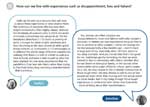 |
Rachel Nicholls and Jonathan Buckley discuss: |